
Understanding Typography Anatomy: A Practical Guide for Designers
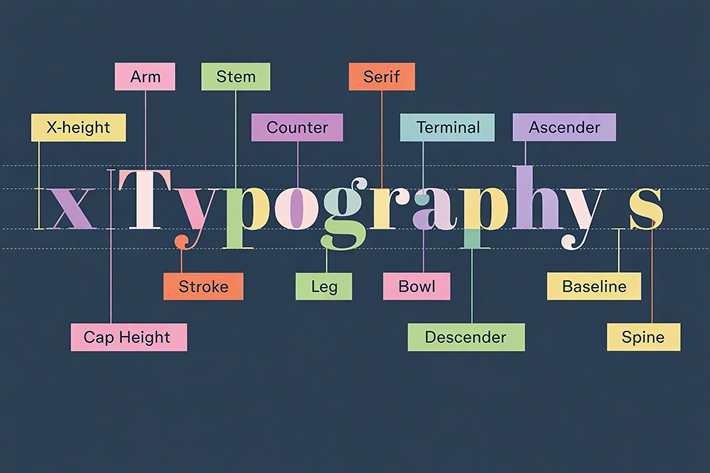
Typography plays a crucial role in both how a design looks and how it functions. When designers understand the structure behind type, they can make more intentional decisions that enhance clarity, direct attention, and support a better user experience across digital and physical mediums.
By studying the parts that form letter shapes, designers gain the ability to improve legibility, express personality, and establish a strong visual framework—from small interface text to large-scale brand identities.
What you’ll explore in this guide
- Fundamental typography principles and their practical use
- The structural elements that form letter shapes
- Why typography anatomy matters in design decisions
- Practical guidance for applying type anatomy in real projects
What Does Typography Anatomy Mean?
Typography anatomy describes the individual elements that construct a typeface, including strokes, curves, spacing, and decorative details. Each element influences how text is perceived, how easily it can be read, and how well it performs in different environments.
A solid understanding of these parts helps designers choose and refine typefaces with confidence, leading to clearer communication and more consistent visual outcomes.
Core Principles of Typography
Effective typography relies on a set of foundational principles that help text communicate clearly and efficiently. These principles support structure, accessibility, and visual balance across layouts.
- Alignment - Organizing text to create order and visual flow
- Color usage - Applying color to support emphasis and mood
- Consistency - Repeating type choices to strengthen clarity
- Contrast - Differentiating text elements using size, weight, or style
- Hierarchy - Structuring information so readers know where to look first
- Readability - Ensuring text is comfortable to read in its context
- Scale - Using size to signal importance
- Scannability - Making content easy to skim and absorb
- Typeface selection - Matching font style to message and tone
- Spacing - Controlling space to improve flow and comprehension
The Three Foundations of Typography Anatomy
Typography anatomy can be understood through three interconnected areas: letter structure, spacing and measurement, and type classification. Together, these aspects help designers create text that is both functional and expressive.
Letter Structure and Components
Every letter is built from specific structural parts that define its form and character. These elements influence rhythm, balance, and overall personality.
- Arm - A stroke that extends from a character without connecting to another stroke
- Ascender - The portion of a lowercase letter that rises above the main body
- Baseline - The invisible line on which characters rest
- Bowl - A curved stroke that encloses space within a letter
- Cap height - The height of uppercase letters
- Counter - The negative space inside or around a character
- Descender - The portion of a letter that falls below the baseline
- Leg - A downward, often angled stroke extending from a character
- Serif - A small finishing stroke at the end of a main stroke
- Spine - The central curved stroke in certain letters
- Stem - The main vertical stroke of a character
- Stroke - Any line forming part of a letter
- Terminal - The end of a stroke without a serif
- X-height - The height of lowercase letters, which strongly affects readability
Spacing and Measurement
Typography isn’t just about letter shapes—the space between and around them is equally important. Proper spacing improves legibility, comfort, and overall rhythm.
Careful spacing ensures text feels balanced and easy to read.
- Kerning - Adjusting space between specific letter pairs
- Leading - The vertical distance between lines of text
- Tracking - Uniform spacing applied across words or text blocks
Typeface Categories
Typefaces are grouped into classifications based on shared visual and structural traits. Knowing these categories helps designers choose fonts that align with the desired tone and function.
- Sans serif - Clean and modern, without decorative strokes
- Serif - Traditional fonts with decorative endings
- Slab serif - Bold serif styles with thick, block-like endings
- Monospaced - Fonts where all characters have equal width
- Script - Flowing styles inspired by cursive writing
- Handwriting - Informal, hand-drawn letterforms
Why Typography Anatomy Matters
Understanding typography anatomy allows designers to make smarter, more intentional choices. It supports:
- Clear visual hierarchy and content flow
- Improved accessibility and readability
- Stronger emotional tone and personality
- Better font combinations and pairings
- Consistent visual systems across platforms
Typography becomes a tool for communication, not just decoration.
Practical Tips for Using Typography Anatomy
- Adjust spacing based on letter shapes and negative space
- Balance typefaces by aligning baselines and proportions
- Compare anatomical traits when pairing fonts
- Choose fonts with open shapes for small text
- Use stroke contrast carefully to emphasize without overwhelming